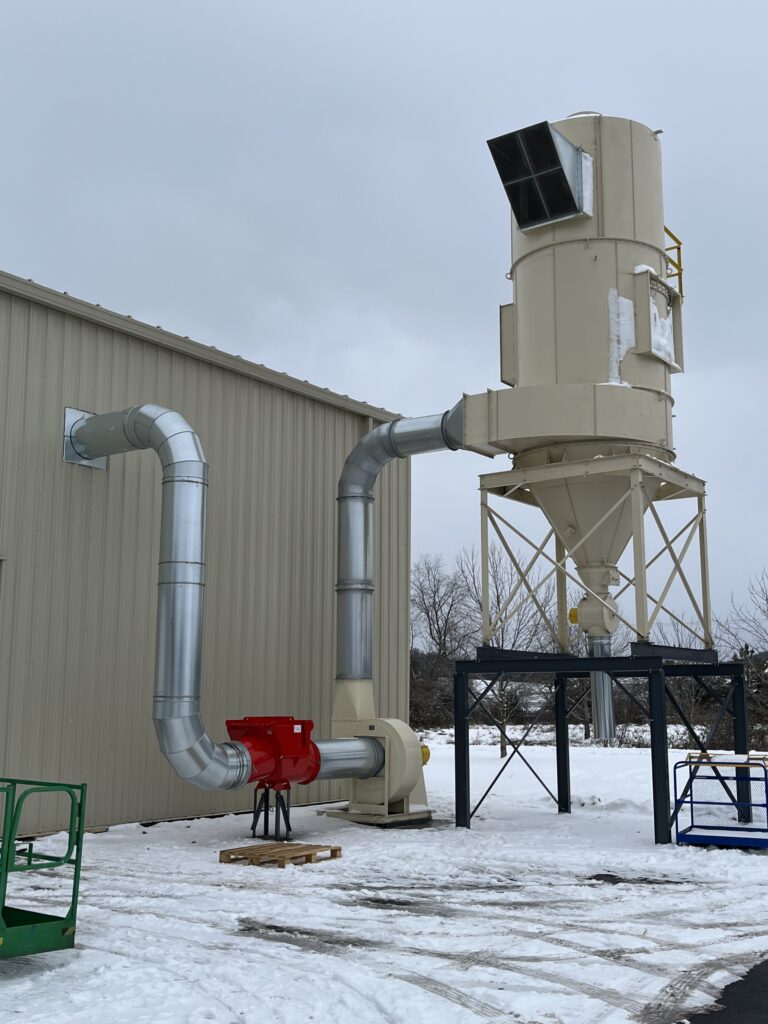
This case study looks at a reverse air baghouse installed at a manufacturing plant to capture wood dust. The wood dust is filtered through the baghouse and the clean air is exhausted out to the atmosphere. The customer purchased this baghouse from a used equipment dealer and contracted Precision Industrial to do some repair work on the unit and install the complete system.
The customer was able to take advantage of a large cost savings by purchasing a used dust collector as opposed to a new one. Reverse air baghouse dust collectors are engineered for efficient operation in demanding installations with high airflow and high dust loads. Mechanical simplicity makes these weather-tight filters mechanically superior. They are reliable, durable, economical, and maintain lower and more consistent emission levels than competing units. The reverse air baghouse design utilizes a single on-board direct-drive fan or an external blower which minimizes energy cost by taking away the need for compressed air. The bags are cleaned by reverse air that is flushed through the dust collecting bags. The dust that has accumulated on the bags is knocked down into the hopper where it is discharged out through the bottom of the collector. Years of use by major processors in diverse industries attest to their outstanding long-term performance.
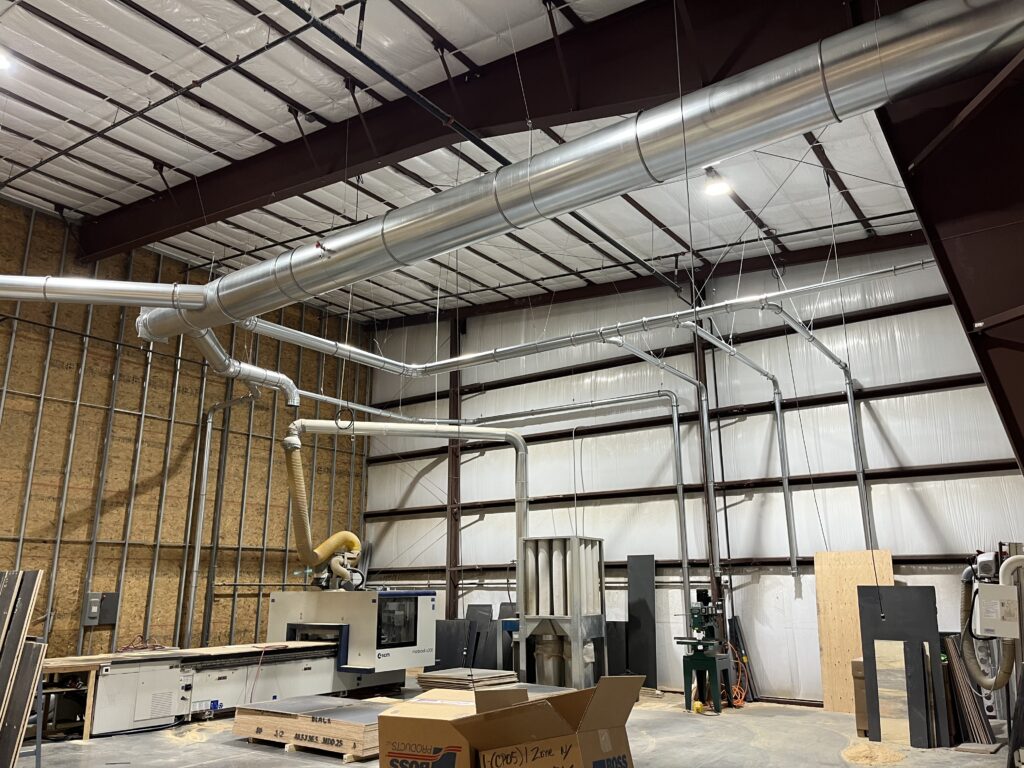
The used dust collector was shipped to the new plant location where the Precision Industrial installation crew went to work. There were some spare parts that needed to be replaced on the dust collector to get it up to speed. We utilized our extensive network of suppliers to source those parts for the customer. The customer also requested the the unit be lifted up in order to discharge into a dumpster. We had a custom I beam stand designed and fabricated. Once the dust collector was installed outside, the installation of the interior ductwork began. Ductwork was run to all the dust producing machines in the production area. The machines were currently connected to indoor dust collectors that would eventually be removed. The ends of the duct runs were left open so that the customer could make a quick connection to his machinery one the system was wired up and ready to go. The uses of clamp together ductwork was used which speeds the installation time, saving on costly labor. This also provides a much greater ability to move and change the ductwork layout by simply un-clamping and re-clamping ducts in different locations. Once the installation was complete, the customer had a complete air pollution control system at a substantial cost savings.